


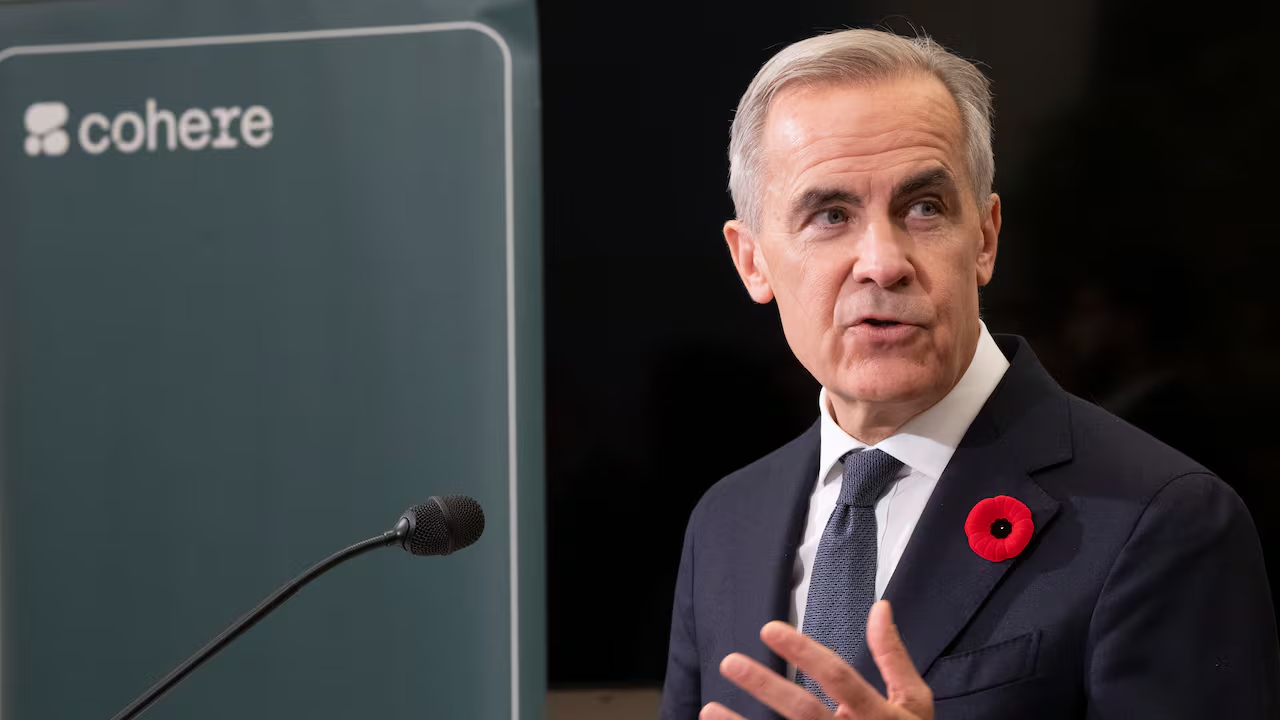
Prime Minister Mark Carney used a Canada-EU summit in Montreal to announce a federal equity stake in Cohere, and this report explains what Canada gets in return and which terms remain undisclosed.
The federal government is taking an ownership stake in one of the country’s best-known artificial intelligence companies. On October 29, 2026, Prime Minister Mark Carney announced a Cohere investment of up to $1.6 billion, committing Ottawa to an equity position in the Toronto-based AI developer.
Carney made the announcement in Montreal while hosting European Union leaders at a summit meant to strengthen Canada-EU ties. The federal money forms part of a Series E funding round led by Germany’s Schwarz Group, which is seeking up to $7 billion. If the round fills, Cohere would be valued at roughly $36 billion.
In return, Cohere has pledged to spend at least $1.7 billion on new computing infrastructure in Canada by 2030. The company has also given assurances that it will remain incorporated and headquartered in Canada.
How the Cohere Investment Fits Into a $7-Billion Series E Round
Ottawa is not the only backer. The round is being led by the Schwarz Group, the German retail conglomerate behind the Lidl and Kaufland chains. Carney said the other investors include chipmaker Nvidia and Bell Canada, the telecom subsidiary of BCE.
Reported valuations vary slightly. One account puts the figure at about $36 billion and another at $35.7 billion, both based on the round reaching its full $7-billion target. That target has not been reached yet. Cohere has completed only an initial close and has not said how much money has been committed so far or when it expects the round to close.
| Item | What has been reported |
|---|---|
| Federal commitment | Equity investment of up to $1.6 billion |
| Round | Series E, targeting up to $7 billion |
| Lead investor | Schwarz Group (Germany) |
| Other named investors | Nvidia, Bell Canada (BCE) |
| Implied valuation | About $36 billion ($35.7 billion in some reports) |
| Cohere’s Canadian compute pledge | At least $1.7 billion by 2030 |
| Size of Ottawa’s stake | Not disclosed |
| Round closing date | Not specified |
Carney’s Montreal Pitch: Keeping Cohere Canadian
The Prime Minister framed the deal as a matter of national control over a strategic technology. In his speech, he said Cohere would stay Canadian and would create more opportunities for Canadian workers and businesses. He added that its incorporation and headquarters would remain in the country.
Carney also argued that Canada should not wait while the future of artificial intelligence is decided elsewhere by people Canadians do not know or trust. That line points to a broader concern in Ottawa: that the most capable AI systems are being built and controlled by a small number of foreign firms.
The setting mattered as well. Announcing a stake in a Canadian AI champion while European leaders were in the room highlighted the deal’s transatlantic side. Brand Magazine has been following the separate talks on a Canada-EU digital trade agreement ahead of the Montreal summit, and the Cohere announcement adds an investment dimension to that agenda.
Cohere CEO Aidan Gomez said the government’s backing was “a huge honour.”
Schwarz Group, Aleph Alpha and the European Angle
The Schwarz Group’s role goes back to earlier in the year. In April, the group pledged $780 million to lead this round as part of Cohere’s merger with Aleph Alpha, a German AI developer. Before the deal, Schwarz owned more than 20 per cent of Aleph Alpha.
Schwarz has been spending heavily on digital infrastructure at home. It has put almost $25 billion into new data centres in Germany. Christian Müller, CEO of the group’s technology arm, Schwarz Digits, said the group plans to run Cohere’s models on its STACKIT cloud platform. He described the investment as the next step after the Aleph Alpha transaction.

For readers following the business side, the structure is notable. A European retail giant with its own cloud business is leading the round. A Canadian telecom is participating. A U.S. chipmaker is in the investor group. Ottawa is backing it all. Together, they form a coalition with commercial interests on both sides of the Atlantic.
The $1.7-Billion Compute Commitment Behind the Deal
The most concrete thing Canada receives, beyond its equity, is Cohere’s promise to invest at least $1.7 billion in new computing infrastructure in Canada by 2030. Computing capacity, meaning the data centres and specialized chips used to train and run AI models, has become one of the main bottlenecks in the AI industry.
Cohere said money from the round will go toward three areas:
- Model development: continued work on the company’s core AI models.
- Products for regulated industries: tools aimed at sectors with strict compliance requirements.
- Computing infrastructure: the hardware capacity needed to build and serve those models.
Bell’s involvement also has a history. Bell and Cohere previously signed an agreement for Cohere’s models to run on Bell infrastructure, and Bell’s participation in the round extends that relationship.
What Ottawa Has Not Disclosed Yet
Several important details are still missing. Reports indicate the federal money will be released in stages tied to job-creation and investment targets. However, the full terms of the agreement have not been made public. Neither has the size of the ownership stake Ottawa will hold in exchange for up to $1.6 billion.
Those gaps matter for taxpayers and for anyone assessing the deal’s value. Without the terms, it is not possible to say:
- The percentage of Cohere the government will own once the round closes.
- The specific job and investment milestones that trigger each payment.
- What happens if targets are missed, including whether unpaid funds would be withheld.
- Any governance rights, such as board representation or limits on future sale of the company.
The “up to” wording also means the final federal outlay could be lower than $1.6 billion, depending on how the staged payments play out.
Cohere’s Growth Numbers and Where the Money Goes
Cohere shared new performance figures alongside the announcement. The company said its annual recurring revenue grew 165 per cent year over year as of the third quarter, and that its customer base has reached 300.
Annual recurring revenue is a standard software-industry measure of predictable subscription income. A 165 per cent jump suggests rapid commercial uptake. However, the company did not disclose the dollar value behind that percentage, so the figure shows the pace of growth rather than the scale of the business.
The focus on regulated industries is consistent with a customer base of 300 organizations. Businesses in heavily supervised sectors tend to sign larger, longer contracts and often care about where their data is stored and processed. That is one reason domestic and European computing capacity is central to Cohere’s pitch.

Why Sovereign AI Became a Federal Priority
General context: Governments in many countries have grown concerned about relying on a handful of foreign technology companies for AI systems that are increasingly built into banking, health care, public services and defence. The idea of “sovereign AI” refers to a country keeping meaningful control over the models, data and computing capacity its institutions use.
Carney’s comments in Montreal fit squarely within that thinking. By taking equity rather than offering a grant or tax credit alone, Ottawa gains a direct financial interest in Cohere’s success, along with a public commitment that the company will stay Canadian. The tradeoff is that taxpayers now share in the risks of a fast-moving, capital-hungry industry.
Questions about who controls advanced AI developers are being debated well beyond Canada. Some companies have tried to lock their missions into their corporate structure, as Brand Magazine explored in its look at how Anthropic’s governance ties its safety mission to the boardroom. Ottawa’s approach is different: public ownership combined with conditions on jobs, investment and headquarters location.
Note: The valuation and round size are targets based on the round closing in full. The federal stake and payment terms have not been publicly confirmed, so these figures may change as more details are released.
Frequently Asked Questions
How much is Canada investing in Cohere?
Up to $1.6 billion as an equity investment. Reports say the money will be paid in stages tied to job and investment targets.
How much of Cohere will the government own?
Not disclosed. The size of Ottawa’s stake and the full terms have not been made public.
Who else is investing in the round?
Germany’s Schwarz Group is leading the round. Nvidia and Bell Canada are among the other named investors.
What has Cohere promised in return?
It will invest at least $1.7 billion in new computing infrastructure in Canada by 2030, and its incorporation and headquarters will remain in Canada.
When will the funding round close?
Not specified. Cohere has completed only an initial close and has not said how much has been committed so far.