


From Ottawa's retaliatory duties taking effect to a union deadline at Stellantis, here is what will move Canadian markets and boardrooms over the next five days.
The Canadian business week ahead is dominated by one date: Tuesday, when Ottawa’s counter-tariffs come into force on nearly $28 billion worth of American products. It is the sharpest retaliatory step Canada has taken since trade negotiations with Washington collapsed last month, and it lands just as bankers, grocers, airline executives and autoworkers all face their own moments of reckoning over the next five days.
Prime Minister Mark Carney announced the tit-for-tat measures after the talks broke down and the United States imposed fresh tariffs on roughly $28 billion in Canadian goods. What follows over the week is, in effect, a running read on how much damage the escalation is doing: a major bank summit convened amid rising anxiety about the economy, quarterly results from a tour operator squeezed by fuel costs, an earnings report and annual meeting from one of the country’s largest grocers, and a union deadline over the fate of an idled Ontario assembly plant.
The Canadian Business Week Ahead at a Glance
| Day | Event | Why it matters |
|---|---|---|
| Tuesday | Canada’s counter-tariffs take effect on nearly $28 billion of U.S. products | First day of measurable cost pressure on importers and cross-border supply chains |
| Wednesday | Scotiabank’s annual global banking and markets financial summit opens | Senior financial executives speak publicly as concerns about the economy build |
| Thursday | Transat A.T. Inc. third-quarter results and analyst call | Detail on record jet fuel costs and talks with the federal government |
| Thursday | Empire Co. Ltd. first-quarter results and annual meeting | Grocery pricing, store openings and pharmacy expansion under scrutiny |
| Friday | Unifor’s internal deadline for a tentative deal with Stellantis | Decides the immediate outlook for the idled Brampton, Ont. plant |
Counter-Tariffs on Nearly $28 Billion of U.S. Products Begin Tuesday
Canada’s retaliation is calibrated to mirror the American action almost dollar for dollar: roughly $28 billion in U.S. goods answering roughly $28 billion in Canadian goods hit by Washington’s new duties. That symmetry is deliberate. It signals proportionality rather than escalation for its own sake, while still imposing a real cost on the exporters and importers caught in between.
For businesses, Tuesday is not an abstraction. Duties apply at the border from the moment they take effect, which means purchase orders already in transit, contracted prices and margin assumptions all have to be re-checked. Companies that source components, packaged goods or equipment from American suppliers are the first to feel it, and the effect typically shows up in landed costs before it shows up in shelf prices.
Readers tracking the escalation can compare the scope of this round with the earlier measures detailed in our report on how Canada’s counter-tariffs hit C$27.6-billion of U.S. imports, and with the separate American restrictions covered in our coverage of the Trump administration’s Canadian alcohol import ban.

How the Collapse of Trade Talks Set Up Carney’s Response
The sequence matters for understanding why the duties look the way they do. Negotiations between Ottawa and Washington broke down last month. The United States then imposed new tariffs on about $28 billion in Canadian goods. Carney responded with the matching counter-measures now taking effect.
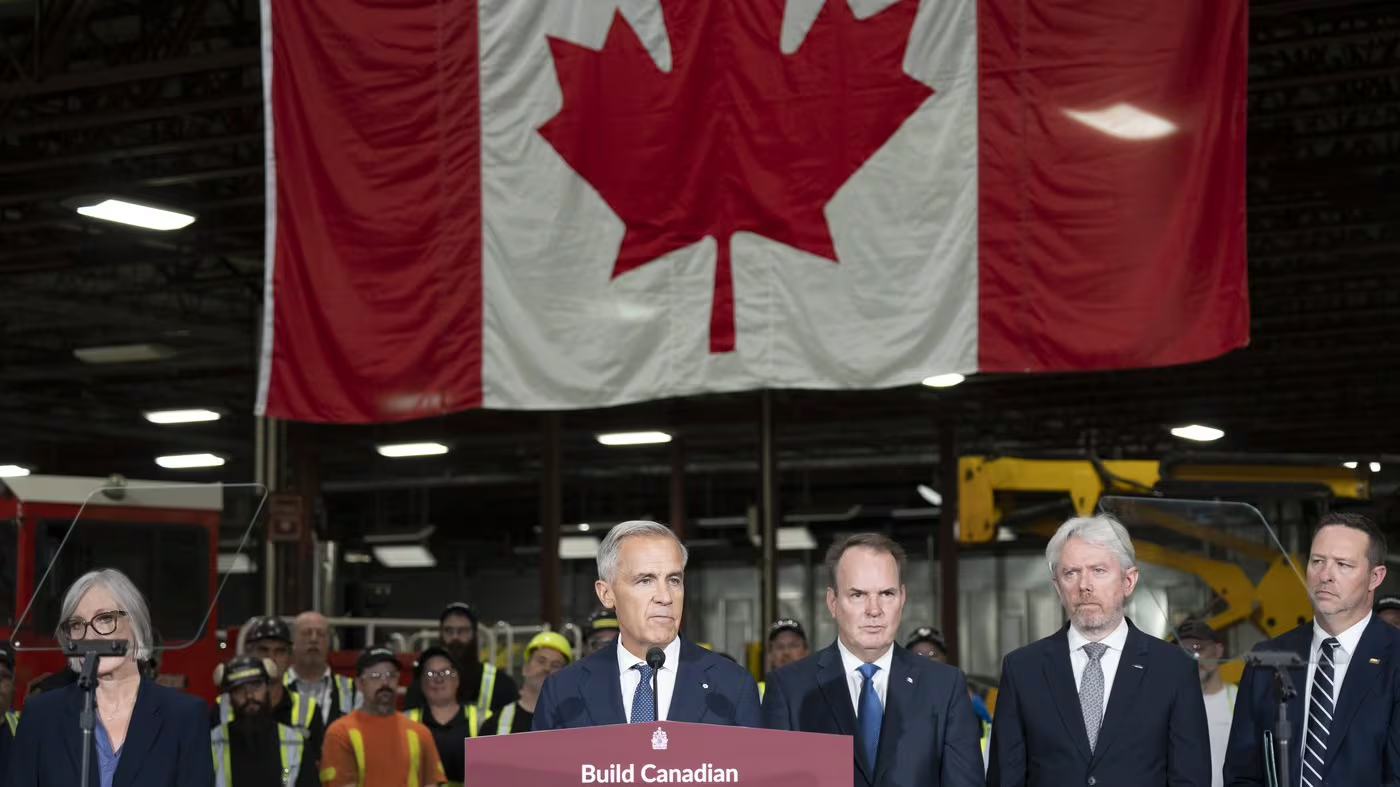
The Prime Minister has framed the dispute in unusually blunt terms, arguing that the American approach is aimed at eliminating Canadian industries or reducing them to subsidiaries of U.S. firms. He spent part of the previous week at the Alstom rail plant in Thunder Bay, Ont., a setting that underlines the government’s emphasis on domestic manufacturing capacity as the trade fight widens.
Ottawa has also been pulling other levers to cushion households and businesses, including the decision to keep fuel excise tax relief in place through Jan. 31, 2027. Taken together, the measures suggest a strategy of matching pressure at the border while trying to hold down input and consumer costs at home.
Scotiabank’s Global Banking and Markets Summit Opens Wednesday
Scotiabank hosts its annual global banking and markets financial summit beginning Wednesday, with senior executives from across banking and financial services expected to speak. In an ordinary year the conference is a scheduled diary item. This year it is one of the few places where the people who price risk for the Canadian economy will talk publicly, on the record, in the same week retaliatory tariffs begin.

The questions are not hard to guess. General industry context: at bank conferences held during periods of trade disruption, the recurring themes tend to be credit quality in exposed sectors, the pace of business lending, and how much capital institutions set aside for potential loan losses. Investors will be listening for any shift in tone about the Canadian outlook rather than for headline announcements.
Nothing has been published about the summit’s agenda or speaker list beyond the sector-wide executive attendance noted above, so specific commitments or forecasts from the event remain to be seen.
Transat’s Third Quarter and Its Talks With Ottawa
Transat A.T. Inc. reports third-quarter results Thursday morning and will hold a call with investors and analysts. The tour operator and airline group has already flagged the central problem: it paid more than ever before for jet fuel during the quarter, a consequence of the ripple effects of the Iran war on global energy markets.
The company said last month that it was in discussions with the federal government “to explore potential solutions.” Neither the nature nor the scope of any potential federal support has been disclosed, and Transat has not detailed what form those solutions might take.

That makes Thursday’s call the most closely watched item on the corporate calendar this week. Fuel is typically among the largest single cost lines for an airline, and a record quarter for fuel spending puts pressure on pricing, capacity planning and the balance sheet at the same time. Analysts will be looking for updated guidance and for any characterisation of where the talks with Ottawa stand.
Empire’s First Quarter, Its New Stores and Its Pharmacy Push
Empire Co. Ltd. releases first-quarter results and holds its annual meeting on Thursday. The company operates a portfolio of banners familiar to shoppers across the country, including Sobeys, Safeway, FreshCo and Farm Boy, and has said it is moving to open more stores over the next three years while expanding its pharmacy footprint.
Grocery results carry outsized political weight in Canada, and this quarter arrives with tariffs in the news. Food retailers sit at the end of long, partly cross-border supply chains, which is why their commentary on sourcing and cost pass-through tends to be read as an early indicator of where household prices are heading.
The combination of an earnings release and an annual meeting on the same day also means shareholders get a rare opportunity to question management directly on the store growth plan and the pharmacy strategy in the same news cycle.

Unifor’s Friday Deadline and the Idled Brampton Assembly Plant
Unifor has set Friday as an internal deadline to reach a tentative agreement with Stellantis, the final round in this cycle of auto sector bargaining. At the centre of the negotiation is the future of the automaker’s assembly plant in Brampton, Ont., which has been idled since 2023.
An idled plant is a different bargaining problem than an operating one. The union’s concern is product commitment, the assurance that a vehicle will be allocated to the facility and that the workforce has a defined path back. That is the kind of pledge that is usually secured, if at all, in the language of a collective agreement rather than in a press release.
It is worth being precise about what Friday is: an internal target the union has set for itself, not a strike deadline or a legally fixed cut-off. The outcome, or the absence of one, will nonetheless be read as a signal about Stellantis’s longer-term Canadian manufacturing intentions at a moment when the entire North American auto trade relationship is unsettled.
The Common Thread Running Through All Five Events
Each item on this week’s calendar was scheduled independently, yet they converge on the same question: how much of the trade conflict is now showing up in real numbers. Tariffs create the cost. Bank executives price the risk. Transat quantifies an energy shock. Empire reports from the consumer end of the chain. Unifor negotiates over an asset whose value depends on cross-border industrial policy.

For readers following Canadian business, that is what makes the coming five days more informative than a typical week-ahead list. By Friday there should be considerably more evidence, in earnings figures and executive commentary rather than in political statements, about what the escalation is actually costing.
Frequently Asked Questions
When exactly do Canada’s counter-tariffs take effect?
They are set to take effect on Tuesday, and apply to nearly $28 billion worth of U.S. products.
Which specific U.S. goods are covered by the new counter-tariffs?
The detailed product list is not specified in the material reported here; only the overall value of nearly $28 billion has been confirmed.
Why is Transat in talks with the federal government?
Transat said last month it was in discussions with Ottawa “to explore potential solutions” after paying more than ever for jet fuel in its third quarter because of the ripple effects of the Iran war. The nature of any support has not been disclosed.
Is Friday a strike deadline in the Stellantis talks?
No. It is an internal deadline Unifor has set for reaching a tentative agreement. No strike date has been announced.
How long has the Brampton assembly plant been idle?
Since 2023, according to the union’s account of the negotiations.