


A former Ontario finance minister argues Canada's infrastructure problem is no longer money or ambition, but whether its institutions can turn trust into execution.
The Canada Investment Summit brought some of the world’s largest institutional investors to Toronto in mid-September 2026, and with them a question that no amount of capital can answer on its own: can this country still build at scale? Hosted by Prime Minister Mark Carney in partnership with CPP Investments and PSP Investments, the event was convened to mobilise financing for the next generation of Canadian infrastructure, with roughly $1 trillion in targeted investment framing the discussion.
Writing as the summit opened, former Ontario finance minister and deputy premier Dwight Duncan argued that the harder constraint is not money at all. It is whether Canada’s governments, investors, Indigenous partners and communities can collectively make the difficult choices that turn ambition into concrete and steel.
Who Convened the Toronto Summit and What Was on the Table
The gathering was Canada’s first Investment Summit of its kind. Carney hosted it alongside two of the country’s largest pension managers, CPP Investments and PSP Investments, giving the event an unusual structure: a head of government and domestic pension capital jointly making the pitch to global allocators.
Carney delivered remarks to Canadian business leaders at a welcome reception in Toronto on Sunday, September 13, 2026, with the main programme following that week. Alongside the capital-raising objective, the summit doubled as a political test — panels during the week examined the implications of Carney not only hosting the event but attempting to secure investment commitments on the trillion-dollar scale being discussed.
The agenda arrived in the middle of a busy federal calendar. Readers following the policy side of the story can see how the event fed into Ottawa’s fall agenda after the Investment Summit, and how it sits alongside the government’s broader legislative plans for the sitting.
Dwight Duncan’s Argument: Confidence Cannot Be Legislated
Duncan held the finance, revenue and energy portfolios in the Ontario legislature and served as deputy premier in Dalton McGuinty’s Liberal government. He is currently Chancellor of the University of Windsor and Senior Advisor, Investor Relations at Bernstein, Litowitz, Berger and Grossmann, and sits on several corporate and not-for-profit boards.

His central claim is blunt. Canada has never lacked ambition, plans or agreement on the destination — more housing, cleaner and more reliable electricity, stronger trade corridors, modern ports and airports, better transit, expanded digital infrastructure. What is unproven, he writes, is the institutional capacity and collective determination to deliver it.
Confidence, in his framing, matters but builds nothing by itself. It has to be expressed through institutions capable of making hard calls, governments capable of acting together, and policy capable of converting national ambition into investible opportunity. “Confidence cannot be legislated,” he argues. “It must be earned — and demonstrated.”
The First Fault Line: Building Versus the Consequences of Building
Duncan identifies two dimensions to the challenge. The first sits inside every government: finding the balance between the need to build and the legitimate consequences of building.
Major projects affect communities, the environment, Indigenous rights and public finances, and he is explicit that those considerations cannot be wished away. But he also warns that a country cannot let fear of every possible externality make large projects effectively impossible to undertake.
Recent federal legislative and regulatory reform is an attempt to rebalance that equation — providing greater certainty, streamlining approvals, cutting duplication and accelerating projects judged to be in the national interest. Duncan says those reforms deserve support, while cautioning that legislation alone will not decide the outcome. Implementation will, and rebalancing will inevitably produce disagreement and some backlash.

The Second Fault Line: Fragmentation Between Ottawa, Provinces and Cities
The second problem runs between governments. Federal, provincial and municipal authorities too often treat infrastructure, energy, transportation and economic development as separate jurisdictional files rather than parts of a single national economic system. For a midsized economy spread across the world’s second-largest country, that fragmentation is expensive.
The deterioration in Canada’s relationship with the United States has forced the issue into the open. Duncan poses it as an open question rather than a settled one: has the external pressure actually made Canada less balkanized, and are governments more willing to look past provincial and regional interests? He sees encouraging signs and reasons for caution, and says the answer will be shown by what is built, not what is said.
Why “Investibility” Has Become the Operative Word
Duncan credits recent work by the CPP Investments Insights Institute with reshaping his thinking. Its research introduces the concept of investibility: whether a market has the regulatory frameworks, scale, revenue models, infrastructure and execution capability that let capital be deployed repeatedly and at scale.
The same research makes a structural point about how sectors now interlock:
- Data centres are not standalone tech projects: they require reliable electricity, transmission capacity, water, land and digital connectivity.
- Advanced manufacturing is a systems problem: it depends on energy, transportation networks, skilled labour and efficient borders.
- AI, power, critical minerals and transport converge: the research treats them as interconnected systems rather than separate asset classes.
That convergence is already visible on the ground. Bell Canada is building what is expected to be the largest Canadian-owned data centre outside Regina, under construction as of late August 2026 — a project that is simultaneously a technology, energy and land-use decision. The same tensions are driving industry commitments such as the responsible data centre development framework now backed by 19 signatories.

From Project by Project to System by System
Duncan’s prescription follows from that analysis. Canada, he argues, has spent too long thinking one project at a time. Instead of presenting investors with a collection of individual opportunities, related projects should be assembled into larger investible platforms and corridors with sufficient scale, predictable revenues and a credible pipeline of future investment.
The scale of what is coming supports the point. Artificial intelligence and advanced manufacturing will demand enormous new generation and transmission capacity. Housing needs roads, water, wastewater and transit. Trade needs efficient ports, rail corridors, airports and border crossings. Energy policy will require continued investment in pipelines, transmission, carbon capture, LNG export facilities and small modular reactors.
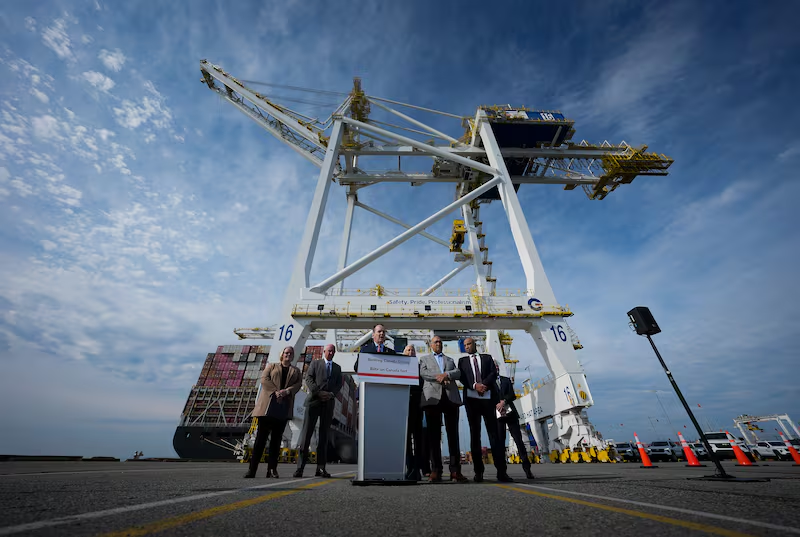
One live example sits on the West Coast. Transport Minister Steven MacKinnon announced on July 16, 2026, at Deltaport at Roberts Bank, B.C., that upgrading the Port of Vancouver had been referred to Canada’s Major Projects Office for possible fast-tracking. The package includes Roberts Bank Terminal 2, a proposed three-berth terminal that would lift container capacity by 50 per cent, plus expanded bulk terminal capacity through land use and infrastructure improvements.
Competing for Capital, Not Simply Mobilising It
Here Duncan parts company slightly with the CPP Investments framing. The research argues that global capital is abundant and the binding constraint is the supply of investible opportunities. He accepts the core point but adds a qualification that matters for Canadian policymakers.
Claims on global capital are expanding at an extraordinary rate. Governments must finance deficits and refinance debt. AI and data centres require enormous investment in generation, transmission and digital infrastructure. Defence spending is rising. Housing, advanced manufacturing, the energy transition and conventional infrastructure will absorb trillions more.

Capital may be abundant in absolute terms, he writes, but it is neither unlimited nor captive to Canada. Investors can weigh Canadian infrastructure against government bonds, American data centres, European defence projects, Asian infrastructure and opportunities almost anywhere else. Regulatory efficiency, policy stability and openness to global capital determine where it lands, and the most common reason capital does not deploy is simply that the risk-adjusted return is better elsewhere.
What the 94 Per Cent Figure Does and Does Not Prove
The encouraging data point Duncan cites is that, in CPP Investments’ survey work, 94 per cent of international investors expect to maintain or increase their Canadian exposure over the next three years. International allocators already value the country’s stability, openness and institutional credibility.
His warning is that trust alone does not move money. Investors also require scale, credible revenues, appropriate risk allocation and a clear path to execution. A country can be trusted and still fail to attract the investment it needs. The better question, he suggests, is how Canada designs projects — and platforms of projects — that capital can finance repeatedly.
The Nobrega Point: Governments Have to Supply the Assets
It is often said Canadian private capital is too cautious relative to its American counterpart, and Duncan allows there may be some truth in that. But he flips the criticism toward government.
He recalls Michael Nobrega, then chief executive of OMERS, repeatedly making a simple point during Duncan’s time in office: OMERS would invest more in Ontario if governments made more suitable assets available. Investors cannot finance opportunities that do not exist.

The implication is that the task is not only persuading Canadian institutional investors to accept more risk. Governments carry a parallel responsibility to build a deeper pipeline of investible assets with workable revenue models and clear risk allocation — and to shape policy so that foreign capital, not just domestic pension money, can participate.
The Partnership Test Behind Every Major Project
Duncan closes on the division of labour that nation-building actually requires. Governments set the policy framework and, where appropriate, invest. Private investors supply capital, innovation and execution. Indigenous partnerships increasingly determine whether projects earn public confidence. Provinces hold many of the levers over energy, resources and infrastructure. Municipalities provide much of the infrastructure that supports housing and local economic growth. Workers build, and communities live with the results.
No government has the fiscal capacity to finance every nation-building project of the coming decades, and Canada cannot assume private capital will automatically fill the gap. Progress, he concedes, will not be linear: some projects will change, some decisions will disappoint, and some investments will not proceed.
His measure of success is behavioural rather than financial — whether governments make timely decisions and coordinate across jurisdictions, whether investors commit patient capital, whether Indigenous partnerships rest on trust and respect, and whether institutions can deliver complex projects responsibly. The opportunity before the summit, as he frames it, is to convert Canada’s reputation for trust into a reputation for execution. That test now moves into the legislative arena, where the Carney government’s fall parliamentary agenda will determine how quickly the reform promises are implemented.
Frequently Asked Questions
Who hosted the Canada Investment Summit and when did it take place?
Prime Minister Mark Carney hosted it in Toronto in partnership with CPP Investments and PSP Investments, with a welcome reception on Sunday, September 13, 2026, and the summit running that week.
What is the $1 trillion figure associated with the summit?
It is the scale of targeted investment discussed at and around the event, referenced in panel commentary on the political implications of the summit. It is a discussion figure, not a confirmed set of signed commitments.
What does “investibility” mean in this context?
It is a concept from CPP Investments Insights Institute research describing whether a market has the regulatory frameworks, scale, revenue models, infrastructure and execution capability for capital to be deployed repeatedly and at scale.
Who is Dwight Duncan?
A former Ontario cabinet minister with the finance, revenue and energy portfolios and deputy premier under Dalton McGuinty. He is Chancellor of the University of Windsor and Senior Advisor, Investor Relations at Bernstein, Litowitz, Berger and Grossmann, and serves on corporate and not-for-profit boards.
What Canadian projects were cited as examples?
The Port of Vancouver upgrade, including the proposed three-berth Roberts Bank Terminal 2 referred to the Major Projects Office in July 2026, and Bell Canada’s data centre under construction outside Regina.