


Scientists identify eight interconnected mechanisms driving unprecedented polar ice loss, warning of a potential double Blue Ocean event.
Record Ocean Temperatures Trigger Polar Ice Emergency
On August 23, 2026, the world recorded its highest sea surface temperature on record: a global average of 21.24°C (70.23°F), representing an anomaly of +1°C above the 1982–2010 baseline. The same day, global sea ice area fell to 3.02 million km² below the 1981–2010 average—the second-lowest anomaly on record for that date and a deviation of -4.58 standard deviations.
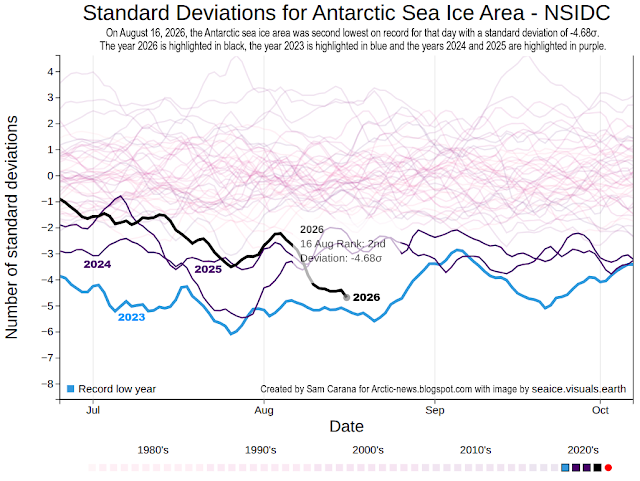
Antarctic waters are experiencing the most dramatic changes. On August 13, Antarctic sea ice area was 2 million km² below the 1981–2010 average, with a deviation of -4.44 standard deviations. By August 16, the anomaly had worsened to -4.68 standard deviations. Scientists tracking these changes note that the 2026 El Niño event is tracking toward becoming the strongest on record, compounding stress on ice systems at both poles.
Eight Mechanisms Accelerating Polar Ice Loss
Ocean heat alone does not explain the rapid ice decline. Climate researchers have identified eight interconnected mechanisms simultaneously warming polar waters and accelerating ice melt:
Ocean heat transport: Warm water from the North Atlantic is being pushed along the Gulf Stream path through the Fram Strait into the Arctic Ocean. Sea surface temperatures as high as 34°C (93.2°F) were recorded around North America on August 22, 2026, facilitating northward heat transfer. Similar warm-water intrusions are occurring in Antarctic regions.
Insolation and atmospheric heating: During polar summer months, intense sunlight directly heats ocean water. Simultaneously, heatwaves on land extend over polar oceans, and warm air masses are pushed over water by strong winds, further raising sea surface temperatures in areas where ice has already disappeared.
Wind pattern and ocean current changes: Polar amplification of global warming is narrowing the temperature difference between the Equator and the Poles, which can slow and distort critical wind patterns such as the Jet Stream and ocean circulation systems like the Atlantic Meridional Overturning Circulation (AMOC). These changes allow ocean heat to accumulate and then suddenly surge into polar regions.
Albedo reduction: As snow and ice cover declines, less sunlight is reflected back to space. Aerosols such as soot and dust settling on remaining ice further darken the surface. Increased plant and algae growth in warming regions also reduces reflectivity, creating a self-reinforcing warming cycle.
Emissivity shifts: Research shows that open oceans are less efficient than sea ice at emitting far-infrared radiation. This means open water retains more heat energy, which further melts surrounding ice and raises polar temperatures.
Warm runoff from land: As coastal regions around the Arctic warm, river discharge and groundwater flowing into polar oceans become warmer. The Bering Strait recorded sea surface temperatures of 18.2°C (64.76°F) on August 17, 2026. In some regions, river water was measured at 16.2°C above historical norms, adding thermal stress to ice systems.
Loss of the latent heat buffer: Snow and ice normally absorb large amounts of heat energy as they melt, acting as a thermal buffer. As this buffer disappears, the same amount of incoming heat causes much larger temperature increases in the remaining water.
Compound feedbacks and extreme weather: Multiple feedback mechanisms amplify each other. Heatwaves, lightning, fires, and ozone depletion interact with ice loss to create cascading warming effects. Methane eruptions from warming seafloor can also dramatically accelerate temperature rise.
Atmospheric Rivers Bring Warm, Moist Air to Antarctica
A critical mechanism is now accelerating Antarctic ice loss: atmospheric rivers carrying warm, moist air are reaching the continent. On August 22, 2026, an atmospheric river with total cloud water content of 1.63 kg/m² was recorded over the Southern Ocean. Precipitation accumulation reached 7.5 kg/m² at the same location, with relative humidity at 100%.
Air temperatures near the Antarctic surface reached 0°C (32.1°F) over sea ice on August 22, and 4.1°C (39.3°F) at 1000 hPa over the Antarctic ice sheet itself. These temperatures are far above the normal winter conditions at the South Pole, where temperatures typically remain below -60°C (-76°F). The Jet Stream, which normally circles Antarctica and maintains cold conditions, is now crossing over the continent, allowing warm, moist air to penetrate regions historically isolated by the polar vortex.
Snowfall Paradox: Why More Snow Accelerates Ice Loss
Increased atmospheric moisture is causing heavy snowfall over the Antarctic ice sheet. While snowfall might seem to add ice, it creates a dangerous feedback mechanism. As snow accumulates, the Southern Ocean surface becomes increasingly salty due to the concentration of salt left behind during ice formation.
Salty water has a critical disadvantage: sea ice can begin melting at approximately -2°C (28.4°F), whereas freshwater remains frozen until 0°C (32°F). Saltier surface waters also sink more readily, allowing warmer deep ocean water to rise and melt ice from below—even during winter months. This vertical circulation draws up additional salt from deeper layers, reinforcing a self-amplifying feedback loop that makes ice reformation progressively harder.
El Niño, Ice Loss, and Methane: A Convergence of Risks
The convergence of three factors creates an exceptionally dangerous scenario. The 2026 El Niño is tracking toward record strength, global sea surface temperatures are at all-time highs, and Antarctic sea ice is collapsing at rates comparable to the 2023 crisis. Research published in 2025 has highlighted the potential for methane eruptions from warming Antarctic seafloor to accelerate warming further.
Scientists warn that the combination of these mechanisms could trigger a double Blue Ocean event—simultaneous loss of sea ice in both the Arctic and Antarctic. Such an event would dramatically reduce the planet’s reflectivity and accelerate global temperature rise. The year 2026 is tracking similarly to 2023, when Antarctic sea ice experienced a dramatic collapse, suggesting a link between tropical ocean warming and polar ice loss.
Water Vapor, Ozone, and Extreme Precipitation
As ocean temperatures rise, more water evaporates into the atmosphere. Water vapor is itself a potent greenhouse gas, amplifying warming. Additionally, water vapor that reaches the stratosphere can damage the ozone layer. The forecast for August 21, 2026, showed precipitable water anomalies extending across Antarctica, indicating the potential for continued extreme precipitation events.
The International Panel on Climate Change (IPCC) Sixth Assessment Report projects that annual maximum daily precipitation will increase significantly with each degree of warming. At a 1.5°C rise above pre-industrial levels, precipitation extremes intensify; at 2°C, 4°C, or higher, the changes become severe and widespread.
What Happens Next: Urgency and the Precautionary Principle
Climate scientists emphasize that the situation is dire and unacceptably dangerous. The precautionary principle—acting to prevent harm even when cause-and-effect relationships are not fully proven—demands immediate, comprehensive, and effective action to reduce emissions and limit further warming.
Proposed responses include rapid decarbonization, renewable energy deployment, and in some cases, climate emergency declarations to mobilize resources and political will. The window for limiting Antarctic ice loss and preventing a double Blue Ocean event is narrowing rapidly. Monitoring systems continue to track sea ice extent, ocean temperatures, and atmospheric conditions in real time.
Frequently Asked Questions
What is a “Blue Ocean event” and why does it matter? A Blue Ocean event occurs when sea ice disappears entirely from a polar region during summer, exposing dark ocean water that absorbs far more sunlight than white ice. A double Blue Ocean event—simultaneous loss of Arctic and Antarctic ice—would dramatically reduce Earth’s reflectivity and accelerate global warming.
How do atmospheric rivers affect Antarctic ice? Atmospheric rivers transport warm, moist air to Antarctica. This moisture condenses as snow, which adds weight to the ice sheet. However, the process also increases ocean salinity, which lowers the freezing point of seawater and allows warmer deep water to rise and melt ice from below, creating a net loss of ice.
Why is the 2026 El Niño significant for polar ice? El Niño events warm tropical oceans, which increases global sea surface temperatures and atmospheric moisture. The 2026 El Niño is tracking toward record strength, compounding stress on polar ice systems already weakened by direct ocean heat transport and atmospheric warming.
What is albedo and how does it accelerate ice loss? Albedo is the reflectivity of a surface. White ice and snow reflect sunlight back to space, while dark ocean water absorbs it. As ice melts, more dark water is exposed, absorbing more heat and melting more ice—a self-reinforcing cycle called the albedo feedback.
Can Antarctic snowfall help rebuild ice? Paradoxically, increased snowfall can accelerate ice loss. Snow adds weight and freshwater to the ice sheet, but it also increases ocean salinity beneath the ice. Saltier water freezes at lower temperatures and allows warmer deep water to rise, melting ice from below faster than snowfall can rebuild it.
What role does methane play in Antarctic warming? Warming seafloor can trigger eruptions of methane—a potent greenhouse gas—from subsea deposits. Methane releases would dramatically accelerate warming and further destabilize ice systems. Research published in 2025 has raised concerns about this mechanism in Antarctic waters.
How do wind pattern changes affect polar ice? Polar amplification narrows the temperature difference between the Equator and Poles, which can slow the Jet Stream and distort ocean currents. These changes allow warm water to accumulate and suddenly surge into polar regions, causing rapid ice melt.
What is the precautionary principle and why is it relevant here? The precautionary principle states that action should be taken to prevent harm even when cause-and-effect relationships are not fully proven. Given the dire risks posed by Antarctic ice loss and potential methane release, scientists argue this principle demands immediate action to reduce emissions.


