


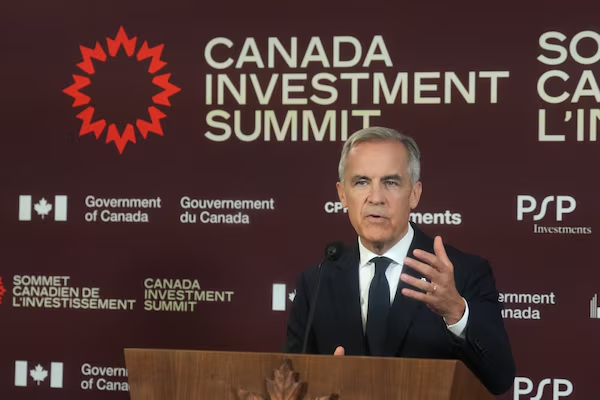
Prime Minister Mark Carney convenes global CEOs and pension leaders in Toronto to showcase billions in domestic projects, infrastructure expansions, and strategic corporate financing.
The 2026 Canada Investment Summit convened hundreds of chief executive officers, international wealth managers, and institutional investors in Toronto to channel private capital into major domestic projects and natural-resource opportunities. As global markets navigate rising protectionism from trading partners, Prime Minister Mark Carney and federal officials welcomed massive financial pledges aimed at modernizing national infrastructure, boosting business productivity, and expanding technological capabilities across the country.
Federal Infrastructure and Productivity Incentives
During the opening sessions of the Canada Investment Summit, Mr. Carney outlined federal initiatives designed to attract foreign and domestic capital into nation-building projects. The government announced plans to finance a new sovereign broadband backbone to connect communities across the country while establishing direct, secure digital corridors to Europe and Asia. This initiative forms part of a broader strategy to reinvest tens of billions of raised capital into critical next-generation infrastructure.

In addition to digital connectivity, Ottawa revealed framework opportunities for private investment in four major international airports located in Vancouver, Calgary, Toronto, and Montreal. While public ownership of the land and core assets will remain with the government, long-term operational concessions will invite private operators to manage passenger-facing amenities much like established models in Europe, Australia, and Asia.

To further accelerate enterprise development, the federal government introduced a comprehensive productivity mega deduction. This policy permits businesses to immediately write off 100 percent of capital investments across an expanded range of 65 percent of assets—including software, computer equipment, fiber-optic cable, mining properties, pipelines, and transportation infrastructure. Consequently, Canada’s marginal effective tax rate on new business investment drops from 13 percent to 6.4 percent, positioning the country competitively among advanced global economies.

Pension Funds and Institutional Capital Commitments
Major institutional players and domestic pension funds utilized the summit to announce substantial equity allocations targeting strategic sectors and critical infrastructure. Notably, the Canada Pension Plan Investment Board (CPPIB) and Brookfield Asset Management Ltd. partnered to establish a $50-billion Maple Fund. Both institutions committed up to $25 billion each over a five-year period to fund vital national development projects.

Other major institutional investors also expanded their domestic portfolios significantly. The Ontario Teachers’ Pension Plan targeted an additional $10-billion deployment in Canada by the end of 2027. Meanwhile, the Public Sector Pension Investment Board announced plans to raise its domestic holdings from $72.4 billion to $100 billion over the next few years.

Corporate financial institutions also made prominent contributions to the economic landscape, reflecting themes similar to recent developments explored in our reporting on the Canada Investment Summit Opens With Carney Before Strasbourg Trip. The country’s major chartered banks committed nearly $325 billion in combined lending, underwriting, and advisory financing. The Toronto-Dominion Bank allocated $150 billion toward energy, critical minerals, aerospace, and digital technology, while the Bank of Nova Scotia and the Bank of Montreal dedicated over $100 billion and $70 billion respectively to critical economic sectors.
Corporate and Venture Capital Expansion Initiatives
Corporate entities across diverse industries announced strategic expansions during the event. Sun Life Financial unveiled an infrastructure investing initiative targeting $5 billion in capital deployment over five years to foster long-term economic resilience. In the technology sphere, BCE Inc. revealed a non-binding memorandum of understanding with Saskatchewan to quadruple its artificial intelligence data center capacity through investments potentially exceeding $5 billion across three new facilities.
Venture capital and private equity groups also expanded their footprint. Radical Ventures secured US$1 billion for a new artificial intelligence fund targeting a total of US$4 billion with backing from major institutional pension funds and banks. Simultaneously, investor Arlene Dickinson launched a $500-million agri-food fund backed by Farm Credit Canada to support food and agricultural enterprises scaling into Southeast Asian markets.
In the energy sector, Carlyle Group-backed Avenrock Energy Inc. agreed to acquire Parallax Energy Operating Inc., securing a 75 percent operating interest in light oil assets within Alberta’s East Shale Duvernay formation. Furthermore, Montreal-based Power Sustainable committed to channeling at least $10 billion into domestic infrastructure and sustainability-focused enterprises over the next five years, effectively doubling its prior investment activity.