


Inside the Strasbourg speech, the tariff threats it triggered, and what a membership category that does not yet exist would have to clear before it becomes real.
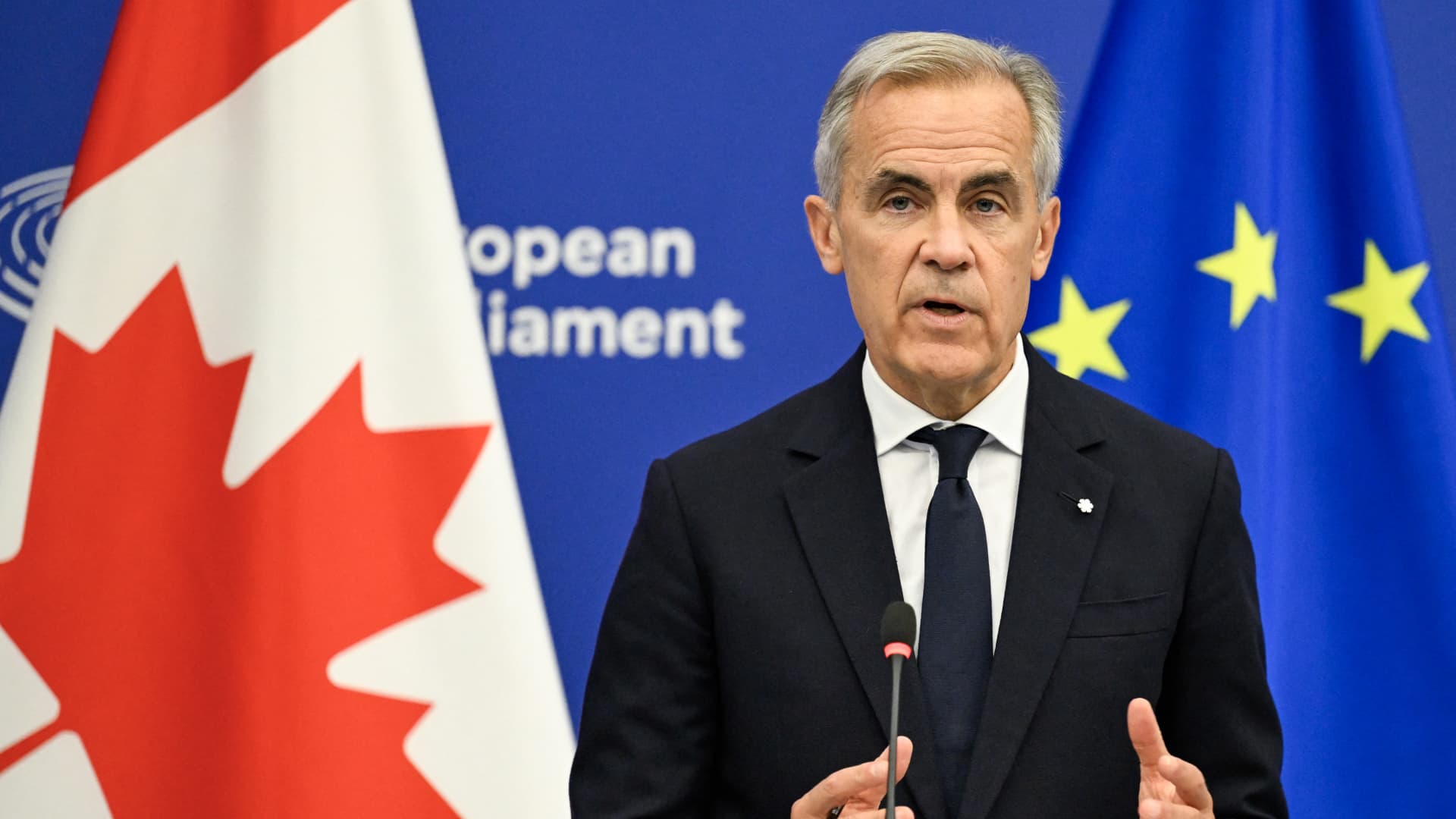
Prime Minister Mark Carney told the European Parliament on Thursday that Canada welcomes the European Union’s offer to make it the bloc’s first EU associate member, a step that would push Ottawa’s relationship with Brussels well beyond the trade deal the two sides have run since 2017. Speaking in the hemicycle in Strasbourg on September 17, 2026, he said Canadian lawmakers would ultimately debate and vote on whatever structure emerges.
“Canada and Europe are each strong. Europe and Canada are stronger together,” Carney told EU legislators. The address came one day after European Commission President Ursula von der Leyen used her state of the union speech to float associate membership for Canada, and two days after U.S. President Donald Trump dismissed the idea as “laughable” and warned the EU it could face heavy tariffs if Washington judged the move a “hostile act.”
Carney’s Warning That Trade Itself Is Being Weaponized
Carney never named Trump in the chamber. He did not need to. “Economic integration is now being weaponized — tariffs being used to exert pressure,” he said, before switching to French to add that financial mechanisms have been turned into instruments of coercion and that supply chains have become “weak points to be exploited.”
That framing is the connective tissue of the whole trip. The Trump administration recently raised tariffs on Canadian goods, and Ottawa answered with levies of its own, with Carney committing to reciprocal measures on a dollar-for-dollar basis. The Strasbourg speech positioned deeper European ties not as a rebuke to Washington but as insurance against the kind of leverage that tariffs create.
What EU Associate Member Status Would Actually Mean
Here is the central caveat for anyone reading the headline as a done deal: associate membership does not currently exist as a formal category under EU treaties. There is no shelf to take it down from. The category would have to be designed first, then created and ratified by member states — 27 governments, each with its own domestic politics.

Carney was candid about the timeline when reporters pressed him on whether Canada’s Parliament would get a say. “Of course, there will be debates, plural, not just a single debate, and there will be a vote in the Canadian Parliament,” he said. “Absolutely, that is clear, but at this particular juncture, we are at the start of a road.” Our earlier report on how the associate member proposal was first unveiled in Strasbourg sets out how quickly the idea moved from concept to podium.
Von der Leyen’s Pitch: From CETA to an “Alliance for the Future”
The existing legal foundation is the EU-Canada Comprehensive Economic and Trade Agreement, or CETA, which eliminated 99% of all tariff lines when it came provisionally into force in 2017. Von der Leyen’s argument is that the relationship has outgrown a trade chapter.
“We will move from CETA to an alliance for the future, to create a common prosperity and economic security space,” she said, telling Carney she wanted to work with him “on opening the door for Canada to being the first associate member of the European Union” and bring ties “to the highest level possible.” She added that the two sides “see the world with the same eyes.”
The stated agenda for that alliance covers five files:

- Trade: building an economic security space on top of CETA’s existing tariff elimination.
- Defence: closer coordination between Canadian and European capabilities.
- Artificial intelligence: joint work on a technology file where both sides are rule-setters rather than dominant producers.
- Climate change: continued alignment on policy and geopolitics.
- Arctic security: a shared northern exposure that has risen sharply up both agendas.
Trump Calls the Plan “Laughable” and Dangles Tariffs on Europe
Speaking to reporters in North Carolina, Trump described Canada as a “terrible trade partner” and said the United States could “stop trading with Europe on many things” if Brussels proceeds. “If it’s a good intention, that’s fine. If it’s a bad intention, we’ll put very heavy tariffs on Europe,” he said.
Carney’s answer, delivered at a news conference after the speech, was to reframe the project as complementary rather than adversarial. “This alliance is a positive process; that’s my response to the American president. A stronger, more resilient, more sovereign Canada will be a more effective partner with the United States,” he said. He then drew a harder line: “Canadians are united that nobody is going to tell us what language we speak, no one is going to dictate our culture or with whom we can strike agreements internationally.”
“We Do Not Seek Power to Dominate Others”
Carney also pre-empted the reading that a Canada-EU alliance amounts to the assembly of a rival power centre. “I’m not proposing a third bloc in order to become a great power rival, only with better manners,” he told the chamber.
“We do not seek power to dominate others. On the contrary, we are pursuing resilience so no one, no one can control our open markets, impair our sovereignty, threaten our territorial integrity, or undermine our freedoms, our democracies, our rule of law,” he said, arguing that the partnership should “create a beacon” for other democracies.

The Ukraine Precedent Working Against a Quick Yes
Brussels has historically resisted flexible membership tiers. Earlier this year, German Chancellor Friedrich Merz pressed the EU to consider associate membership for Ukraine and found little appetite for it. That reluctance is the main structural obstacle to von der Leyen’s Canada proposal, because any new tier invites questions about who else qualifies and on what terms.
What has changed is context rather than treaty law. The Commission president’s public backing for Canada signals a significant deepening of the Ottawa-Brussels relationship at precisely the moment Canada is locked in a bitter trade dispute with its largest trading partner.
The Burnham Meeting and the Defence Track Running Alongside
Before returning to Strasbourg, Carney spent Wednesday in Liverpool with U.K. Prime Minister Andy Burnham, watching Everton play in the Carabao Cup third round at Hill Dickinson Stadium. According to a Downing Street statement, the two leaders stressed the value of building close ties with European partners on trade and defence.
They also discussed deepening defence cooperation, including the complementary roles of the Multilateral Defence Mechanism and the Canada-led Defence Security Resilience Bank. The detail matters because it shows the European turn is not confined to the EU institutions — a parallel bilateral track with London is moving on the security file at the same time.

Why Canadian Business Should Track This File Closely
For Canadian exporters, nothing changes today. CETA remains the operative agreement, tariff lines are unchanged, and no new market access has been created by a speech. What has changed is the direction of travel, and direction is what long-horizon capital prices in.
Diversification away from a single dominant export market has been the running theme of Canadian policy this autumn. The same argument surfaced when the Canada Investment Summit unveiled major capital commitments framed as a counter to protectionism, and Carney’s European itinerary followed directly from the Toronto summit he opened before flying to Strasbourg.
As general market context rather than anything confirmed in this announcement: firms with EU-facing supply chains typically watch three signals in negotiations of this kind — regulatory recognition and standards alignment, procurement access, and mobility or services provisions. None of those have been defined here, and readers should treat any specific commercial forecast as speculation until a negotiating mandate is published.
Frequently Asked Questions
Would associate membership mean Canada joins the European Union?
No. Associate membership is being discussed as a distinct, closer-than-trade relationship, not accession. Carney explicitly ruled out framing it as the creation of a rival bloc.

Does the category already exist in EU law?
No. Associate membership is not a formal category under current EU treaties. It would have to be created and then ratified by member states.
What happens to CETA if this proceeds?
Von der Leyen described the plan as moving “from CETA to an alliance for the future.” No replacement text, timetable or ratification date has been published, so CETA remains the governing trade framework for now.
Will Canada’s Parliament get a vote?
Carney said there will be multiple debates and a vote in the Canadian Parliament on the final structure. No date has been set; he characterised the process as being at “the start of a road.”
Has the U.S. taken any action in response?
Trump has threatened heavy tariffs on the EU if he judges the move hostile and raised the prospect of curtailing some trade with Europe, but the source reporting cites threats rather than implemented measures tied specifically to this proposal.